.png)
HARD SHELL VS SOFT SHELL HYPERBARIC CHAMBER: THE OXYGEN DIFFERENCE EXPLAINED

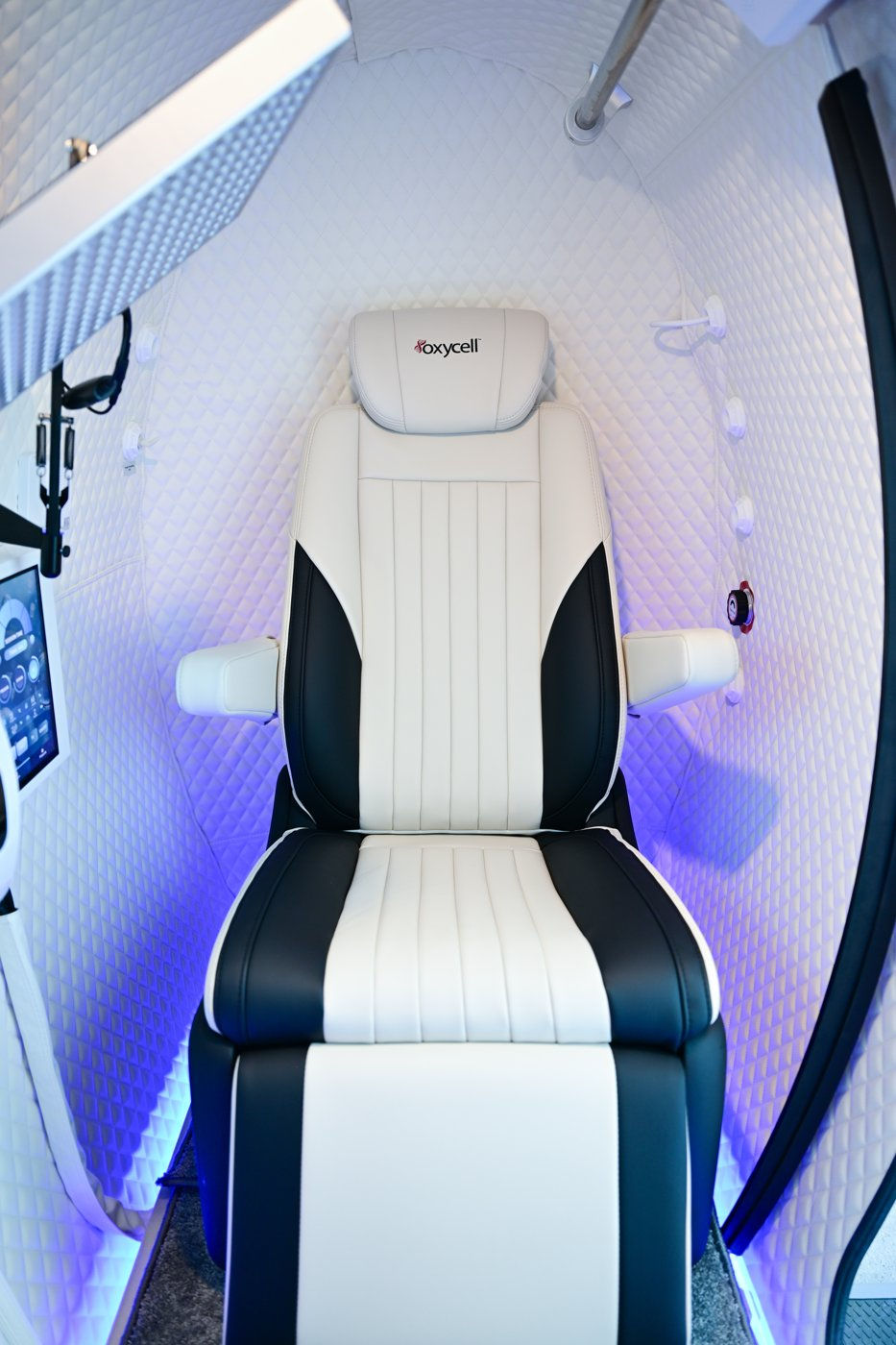
The hard shell vs soft shell hyperbaric chamber question comes down to pressure and oxygen. Hard-shell chambers can reach 2.0 atmospheres (ATA) or more with close to 100% oxygen, the conditions hyperbaric research is built on. Soft-sided chambers, the inflatable bags sold for spas and homes, typically run between 1.1 and 1.4 ATA, and the FDA has cleared them for one use: altitude sickness. That difference changes how much oxygen reaches your tissues, how much fire risk you take on, and what the research can tell you to expect. Here is what to look for in any chamber, including the hard-shell chamber at Hartwater Wellness.
By Elaine Burris, APRN, FNP-C, Wellness Nurse Practitioner, Hartwater Wellness
Medically reviewed by Scott Bradley Burris, MD, Medical Director and board-certified anesthesiologist. Reviewed October 2026.
THE SHORT ANSWER
Hard-shell chambers are rigid medical devices built to pressure-vessel and fire-safety standards. They can reach 2.0 to 3.0 ATA with close to 100% oxygen.
Soft-shell chambers are zippered, inflatable bags that typically reach 1.1 to 1.4 ATA, usually on room air. The FDA has cleared them to treat altitude sickness only and has not cleared them for use with oxygen concentrators.
The research gap: the Undersea and Hyperbaric Medical Society defines hyperbaric oxygen therapy as treatment at no less than 2.0 ATA and calls "mild" treatment below 1.5 ATA unproven.
The oxygen gap: pressure multiplies the oxygen dissolved in your blood. At 3.0 ATA on pure oxygen, dissolved oxygen alone can meet the needs of resting tissues.
Safety: fire is the rare catastrophic risk in any chamber, and it is why grounding, clothing rules, and trained supervision matter.
WHAT MAKES A HYPERBARIC CHAMBER "HARD" OR "SOFT"
A hard-shell chamber is a rigid pressure vessel. Hospital and clinic chambers are built to the ASME pressure vessel standard for human occupancy and operated under Chapter 14 of NFPA 99, the national fire code for health care facilities, which covers construction, equipment, maintenance, and fire protection. One-person (monoplace) chambers are usually filled with pure oxygen. Larger chambers are filled with air while patients breathe pure oxygen through a mask or hood.
A soft-shell chamber is a fabric bag with a zipper, inflated by an air compressor. FDA clearances for these devices describe operating pressures of about 2 to 4 pounds per square inch above sea level, with relief valves that cap the pressure near 1.3 to 1.4 ATA. They were designed to treat mountain climbers with altitude sickness, and that remains their only FDA-cleared use.
HARD SHELL VS SOFT SHELL HYPERBARIC CHAMBER: THE OXYGEN DIFFERENCE
To understand the hard shell vs soft shell hyperbaric chamber difference, start with how oxygen travels in your blood. Almost all of it rides on hemoglobin in red blood cells, and hemoglobin is already nearly full when you breathe ordinary air. A small additional amount dissolves directly in the liquid part of your blood, the plasma. Pressure is what raises that dissolved amount, because gases dissolve in a liquid in proportion to their pressure (Henry's law). Anesthesiologists work with this physiology every day; it is the reason patients receive extra oxygen in the operating room.
Published figures show the scale:
Room air at sea level: about 0.3 mL of oxygen dissolved in each deciliter of blood.
Pure oxygen at sea level: about 2.0 mL per deciliter.
Pure oxygen at 2.0 to 3.0 ATA: arterial oxygen pressure above 1,500 mmHg, compared with about 100 mmHg on room air.
Pure oxygen at 3.0 ATA: about 6 mL per deciliter, enough to meet the needs of resting tissues without any help from hemoglobin.
A famous 1960 experiment demonstrated that last figure. In the study, titled "Life Without Blood," Dutch surgeon Ite Boerema replaced most of the blood in pigs with fluid, lowering their hemoglobin to as little as 1 gram per deciliter, and kept them alive on pure oxygen at 3 ATA before returning their blood. The pigs walked away unimpaired.
What happens at a soft chamber's 1.3 ATA? Pressurizing room air by about a third raises the oxygen available by a similar proportion, a modest change compared with breathing pure oxygen at 2.0 ATA. Measured tissue data point the same way: in a 2024 study of wound oxygen levels on pure oxygen, readings averaged 161 mmHg at 1.4 ATA and 333 mmHg at 2.0 ATA, roughly double at the higher pressure. Some soft-chamber owners add an oxygen concentrator to close the gap. The FDA has not cleared soft chambers for that use, and Health Canada warned in June 2026 that soft chambers may catch fire, "especially when used in combination with an oxygen concentration device."
WHAT THE RESEARCH USES
The Undersea and Hyperbaric Medical Society (UHMS), which accredits hyperbaric facilities and publishes the indications most insurers follow, defines hyperbaric oxygen therapy as treatment at a pressure of no less than 2.0 ATA in a hard-sided chamber, with most supported treatments delivered between 1.9 and 3.0 ATA. It describes "mild" hyperbaric treatment below 1.5 ATA as unproven.
The most-cited longevity study used those conditions too. Researchers in Israel gave 35 healthy adults aged 64 and older 60 sessions over three months, each 90 minutes of pure oxygen at 2.0 ATA. Telomeres (the protective caps on chromosomes) in several types of immune cells lengthened by more than 20%, and senescent immune cells declined. The study had no control group, measured blood cells rather than health outcomes, and several authors worked for a company that operates hyperbaric centers, so it is a promising early result.
For context on what is established: the FDA has cleared hyperbaric chambers for 13 conditions, including decompression sickness, carbon monoxide poisoning, non-healing diabetic wounds, radiation injury, and sudden hearing loss. UHMS lists 15. Recovery, longevity, cognitive performance, and wellness uses are off-label. The FDA also states that hyperbaric therapy is not proven to cure cancer, Lyme disease, autism, or Alzheimer's disease.
FIRE SAFETY: WHAT EVERY CHAMBER USER SHOULD KNOW
On January 31, 2025, a five-year-old boy died when a hyperbaric chamber caught fire during treatment at a clinic in Troy, Michigan. Prosecutors alleged that safety protocols were not followed, including the patient grounding strap and staffing with a physician or safety supervisor on site. The clinic's former safety manager was sentenced in August 2026 after pleading no contest to involuntary manslaughter; other defendants await trial.
In August 2025 the FDA sent a letter to health care providers after reviewing chamber fires. Its recommendations:
follow the manufacturer's instructions for use exactly
follow fire prevention measures, including proper grounding
train staff, and monitor every patient for the whole treatment
keep up cleaning, maintenance, and safety checks
keep prohibited electrical and static-producing items out of the chamber
dress patients in hyperbaric-compatible clothing, such as cotton
Concentrated oxygen makes fabric, hair, and plastics ignite more easily and burn faster and hotter. That is why the rules about what enters a chamber are strict, and why a soft bag fed by an oxygen concentrator worries regulators.
SIDE EFFECTS AND WHO SHOULD NOT USE A CHAMBER
Most people tolerate hyperbaric sessions well. The common issues are manageable:
Ear and sinus pressure, the same sensation as an airplane descent. You equalize by swallowing or yawning; a rupture of the eardrum is rare.
Temporary nearsightedness after a series of sessions, which typically reverses within about six weeks.
Claustrophobia, less common in a seated chamber with a window and screen.
Oxygen seizures, rare (about 1 to 4 per 10,000 treatments in the medical literature) and the reason sessions include scheduled air breaks.
We screen for ear and sinus problems, lung conditions, certain chemotherapy drugs, and implanted electronic devices before your first session.
HOW WE RUN HBOT AT HARTWATER WELLNESS
Hartwater Wellness uses an FDA-cleared hard-shell chamber that delivers close to 100% oxygen. Every session runs at 2.0 ATA, the pressure the research uses, for 60 to 90 minutes with scheduled air breaks, under physician supervision. You sit upright in a reclining leather seat with climate control and a manufacturer-installed TV. The chamber's instructions for use permit personal devices, so many patients bring a phone or laptop and work through their session.
At Hartwater, every HBOT series is part of a broader protocol. It fits within our Pain and Inflammation, Energy and Vitality, and Anti-Aging and Skin Health categories, and many patients pair it with other therapies, such as NAD+ infusions (see How Long Does NAD IV Therapy Take?).
Pricing: $700 for four sessions (about $175 each), $900 for six (about $150 each), $1,000 for eight (about $125 each), and $1,200 for twelve (about $100 each). HBOT is sold in packages of four or more sessions. Hartwater Wellness is a cash-pay practice; HSA and FSA accepted. Insurance generally covers hyperbaric therapy only for FDA-approved medical indications; patients who need HBOT for one of those conditions are referred to a facility that bills insurance.
SIX QUESTIONS TO ASK ANY HBOT PROVIDER
Is the chamber hard-shell or soft-sided, and what pressure will my sessions use?
Will I breathe close to 100% oxygen, and how is it delivered?
Who supervises my session, and is a trained staff member watching me the entire time?
How is the chamber grounded, and what may I wear or bring inside?
When was the chamber last serviced and safety-checked?
What screening happens before my first session?
FREQUENTLY ASKED QUESTIONS
Do soft hyperbaric chambers work?
Soft chambers raise pressure to about 1.3 ATA, which modestly increases available oxygen. The FDA has cleared them only for altitude sickness, and UHMS considers treatment below 1.5 ATA unproven. Most hyperbaric research uses hard-shell chambers at 2.0 ATA or higher.
What pressure is best for hyperbaric oxygen therapy?
Established medical treatments are usually delivered between 1.9 and 3.0 ATA. The right pressure for you depends on your goal and your health, and your physician should set it. Every session at Hartwater Wellness runs at 2.0 ATA.
Is a hard-shell hyperbaric chamber safer?
Hard-shell chambers are built and operated under pressure-vessel and fire-safety standards, and the FDA has not cleared soft chambers for use with oxygen concentrators. Any chamber's safety depends on grounding, clothing and item rules, maintenance, and trained supervision.
Can you use an oxygen concentrator in a soft chamber?
The FDA has not cleared soft chambers for use with oxygen tanks or concentrators, and Health Canada warns that the combination raises fire risk.
How much does hyperbaric oxygen therapy cost?
At Hartwater Wellness, HBOT is sold in packages: $700 for four sessions, $900 for six, $1,000 for eight, and $1,200 for twelve. Insurance covers HBOT only for specific FDA-approved medical conditions.
SCHEDULE A CONSULTATION
Hartwater Wellness is a physician-led practice at 7200 West University Drive, Suite 170, in McKinney, serving Frisco, Allen, Prosper, Plano, Celina, and Collin County. Schedule online or call (469) 678-8748.
SOURCES
Undersea and Hyperbaric Medical Society, HBO2 Indications (15th edition): https://www.uhms.org/resources/featured-resources/hbo-indications.html
U.S. Food and Drug Administration, "Hyperbaric Oxygen Therapy: Get the Facts" (2021; archived copy): http://web.archive.org/web/20251218065045/https://www.fda.gov/consumers/consumer-updates/hyperbaric-oxygen-therapy-get-facts
U.S. Food and Drug Administration, "Follow Instructions for Safe Use of Hyperbaric Oxygen Therapy Devices: Letter to Health Care Providers" (August 25, 2025): https://www.fda.gov/medical-devices/letters-health-care-providers/follow-instructions-safe-use-hyperbaric-oxygen-therapy-devices-letter-health-care-providers
Health Canada, "Unauthorized soft-shelled hyperbaric chambers may pose serious health risks" (June 16, 2026): https://recalls-rappels.canada.ca/en/alert-recall/unauthorized-soft-shelled-hyperbaric-chambers-may-pose-serious-health-risks-2026-06-16
FDA 510(k) K101262, soft portable hyperbaric chamber cleared for acute mountain sickness: https://fda.innolitics.com/device/K101262
FDA 510(k) K171899, soft chamber with relief valves at 1.3 ATA: https://fda.innolitics.com/device/K171899
Morningstar et al., review of mild and conventional hyperbaric therapy, Medical Sciences 2026;14(3):360: https://doi.org/10.3390/medsci14030360
Thom SR. Hyperbaric oxygen: its mechanisms and efficacy. Plastic and Reconstructive Surgery 2011: https://pmc.ncbi.nlm.nih.gov/articles/PMC3058327/
Bitterman H. Bench-to-bedside review: oxygen as a drug. Critical Care 2009: https://pmc.ncbi.nlm.nih.gov/articles/PMC2688103/
Choi et al., Scientific Reports 2024 (dissolved oxygen at 1 and 3 ATA): https://pmc.ncbi.nlm.nih.gov/articles/PMC10858205/
Van Meter, Frontiers in Medicine 2024 (Henry's law and the Boerema experiment): https://pmc.ncbi.nlm.nih.gov/articles/PMC11493705/
Boerema I et al. Life without blood. Nederlands Tijdschrift voor Geneeskunde 1960;104:949-54 (PubMed 13802034): https://pubmed.ncbi.nlm.nih.gov/13802034/
Sack et al., wound oxygen at 1.4 and 2.0 ATA, Undersea and Hyperbaric Medicine 2024;51(1):1-5: https://pubmed.ncbi.nlm.nih.gov/38615347/
Hachmo Y et al. Hyperbaric oxygen therapy increases telomere length and decreases immunosenescence in isolated blood cells. Aging 2020: https://pmc.ncbi.nlm.nih.gov/articles/PMC7746357/
Michigan Department of Attorney General, charges in the Oxford Center chamber fire (March 11, 2025): https://www.michigan.gov/ag/news/press-releases/2025/03/11/four-charged-in-connection-to-death-of-5-year-old-after-hyperbaric-chamber-explosion
WXYZ Detroit, sentencing of the former safety director (September 2026): https://www.wxyz.com/news/region/oakland-county/ex-safety-director-sentenced-in-fatal-hyperbaric-chamber-explosion-in-troy